
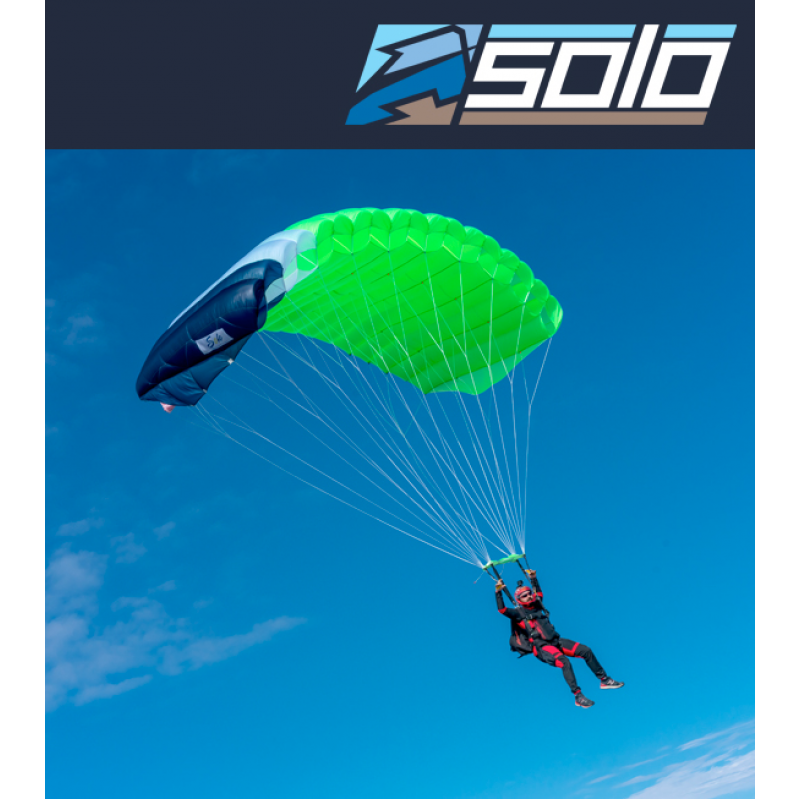
Aerodyne Solo student canopy

€2,500.00
When it’s time for your students to fly solo…
this is the canopy.
It is all about confidence and reliability. Whether you are a drop zone owner or a first jump student, the last thing you need to be concerned with is your equipment. The Solo student canopy can give you that confidence. Strong where it needs to be, forgiving when it has to be, the Solo provides all of the characteristics needed for successful student training. The Solo is durable, with extra reinforcement, while being easy to pack. Its opening flight and landing characteristics have been tailored to allow you to teach your students proper modern piloting techniques. This has become vitally important in today’s world of high performance canopies. We have even considered the difficult transition path from student to novice and beyond. As the student becomes more experienced and is prepared to downsize, the Solo’s design allows for a natural transition to our Pilot canopy. This allows the novice canopy pilot an easy and straightforward transition from student equipment to their own, without the need to “re-learn” the canopy’s characteristics. This provides a much safer and more enjoyable transition, with continued learning. We have even built in visual cues to allow for easier PRO packing training. By utilizing color-coded line attachments, the student learns proper packing techniques in much less time and with greater confidence.
Exciting features:
• Comes standard with 525 lbs. DACRON lines, soft links and a slider with “super lightweight” stainless steel grommets.
• Color coded line attachments for easier PRO packing instruction and learning
• Made completely from ZP fabric to maintain consistent performance.
• Extra reinforcement is provided in areas prone to student damage, resulting in less “down time”
• Moderate “planform factor” for predictable response and handling
• Handling characteristics tuned to provide a smooth transition as the student prepares to downsize.
Available sizes: 190, 210, 230, 250, 270 and 290 sq ft.
Aerodyne Solo Student Canopy – Complete Product Description
Introduction to the Aerodyne Solo Student Canopy
 The Aerodyne Solo Student Canopy stands as a dependable choice for skydiving schools, training programs, and developing jumpers who value stability, predictable handling, and confidence-building performance. Designed with student progression in mind, this canopy combines forgiving flight characteristics with responsive control inputs, allowing new skydivers to improve their canopy skills in a structured and controlled environment.
Modern student canopy systems must support learning while also encouraging gradual skill development. Therefore, the Aerodyne Solo Student Canopy delivers balanced glide performance, smooth flare response, and consistent opening behavior. In addition, the canopy supports instructors who need reliable equipment for repetitive training jumps across different weather conditions and experience levels.
Skydiving schools continue to prioritize equipment that promotes safety, consistency, and ease of use. Consequently, the Solo canopy remains relevant among training organizations that demand durable construction and predictable handling. Because the canopy emphasizes stable flight behavior, students often experience greater comfort during navigation, landing practice, and canopy pattern training.
The Aerodyne Solo Student Canopy features a practical design that supports controlled descents and forgiving landings. Moreover, the canopy encourages better confidence during early jumps, especially for students transitioning from tandem skydives to solo deployments. While experienced skydivers often seek aggressive performance, student-focused canopies prioritize control, reliability, and gradual learning progression.
Throughout the skydiving industry, instructors value equipment that minimizes unnecessary stress during training. As a result, the Solo canopy helps students focus on altitude awareness, landing patterns, steering input, and flare timing. Furthermore, the canopy allows instructors to teach canopy fundamentals without introducing overly sensitive flight behavior.
Designed for Student Progression
The Aerodyne Solo Student Canopy was developed specifically for training progression. Unlike high-performance elliptical canopies, student-oriented designs focus on stability and consistency during every phase of flight. Therefore, the Solo canopy delivers smooth handling characteristics that support learning objectives during early jumps.
Students require equipment that responds predictably to input. Consequently, the canopy incorporates design elements that reduce aggressive reactions while maintaining effective maneuverability. During practice turns, for example, the canopy responds steadily rather than abruptly. Because of this balanced response, students can build canopy control skills with greater confidence.
Learning canopy flight requires repetition and familiarity. In addition, students often perform multiple jumps within short training periods. Therefore, equipment durability becomes extremely important. The Solo canopy supports intensive training operations through robust construction materials and dependable manufacturing standards.
Another important consideration involves landing performance. Students must learn proper flare timing while also maintaining awareness of surrounding traffic patterns. Accordingly, the canopy offers forgiving landing characteristics that reduce the severity of common student mistakes. Although proper technique remains essential, the canopy design supports smoother touchdowns under normal conditions.
Skydiving instructors also appreciate canopies that recover from minor input errors without excessive diving behavior. Therefore, the Solo canopy encourages safer learning experiences during navigation and pattern adjustments. Furthermore, the canopy remains manageable in various training environments, including different drop zone conditions and moderate wind scenarios.
Stable Flight Characteristics
Stability remains one of the defining qualities of the Aerodyne Solo Student Canopy. Because student skydivers are still learning basic flight awareness, canopy stability directly influences confidence and overall comfort in the air.
The canopy maintains a predictable glide path during straight flight. Additionally, the design minimizes unnecessary oscillation during routine maneuvers. As a result, students can focus more effectively on navigation, altitude checks, and landing setup.
During turns, the canopy demonstrates smooth transitions without aggressive roll tendencies. Consequently, students gain valuable experience controlling heading changes while maintaining stable flight awareness. This feature becomes especially important during traffic pattern training, where predictable control improves decision-making.
Opening performance also contributes to overall canopy stability. Therefore, many instructors prioritize equipment that deploys consistently and comfortably. Smooth openings help reduce anxiety among newer jumpers while also minimizing distraction after deployment.
Because the canopy emphasizes stability, it supports a wide range of educational exercises. For example, students can practice flare drills, navigation patterns, and controlled turns with improved confidence. Furthermore, instructors can demonstrate canopy techniques more effectively when equipment responds consistently.
The stable flight profile also benefits students during less-than-ideal conditions. While proper weather limits still apply, predictable canopy behavior helps reduce unnecessary stress during moderate wind changes or busy landing areas.
Reliable Opening Performance
Opening consistency plays a critical role in student training environments. Since new skydivers may feel anxious during deployment, dependable opening behavior supports both comfort and confidence. Therefore, the Aerodyne Solo Student Canopy focuses on controlled deployment characteristics.
A smooth opening sequence allows students to transition calmly from freefall to canopy flight. In addition, controlled deployments reduce excessive body movement that could distract inexperienced jumpers. Because students are still developing altitude awareness habits, calmer openings improve their ability to assess canopy condition quickly after deployment.
Reliable inflation characteristics also assist instructors during training evaluations. Consequently, instructors can focus on student canopy control skills rather than compensating for unpredictable deployment behavior. Furthermore, predictable openings help reduce wear associated with excessively hard deployments.
The canopy’s design supports gradual pressurization during inflation. Therefore, students often experience more comfortable transitions into flight. Although packing technique still affects deployment performance, the canopy remains known for dependable opening characteristics when maintained correctly.
Training programs require equipment that performs consistently across repeated jumps. As a result, the Solo canopy fits well within busy student operations where reliability matters every day. Moreover, dependable openings help reduce mental stress among beginners who are still adapting to independent skydiving experiences.
Responsive Yet Forgiving Handling
Student canopy design requires careful balance between responsiveness and forgiveness. If a canopy reacts too slowly, students struggle to learn proper control timing. However, overly aggressive response can overwhelm inexperienced jumpers. Therefore, the Aerodyne Solo Student Canopy aims to provide manageable responsiveness with predictable recovery behavior.
The steering toggles deliver clear input feedback during navigation exercises. Consequently, students can better understand how their actions affect canopy movement. Because the canopy responds steadily, learning becomes more intuitive throughout progression jumps.
Practice turns under the Solo canopy remain controlled and gradual. In addition, the canopy avoids overly aggressive diving characteristics commonly associated with high-performance designs. This predictable handling allows students to develop safe habits before transitioning to more advanced equipment.
Flare response also contributes to the learning process. Therefore, the canopy provides manageable flare characteristics that support landing practice. Students can improve timing awareness while experiencing smoother touchdown potential.
Many instructors prefer forgiving canopy systems because they encourage safer progression. As a result, the Solo canopy supports structured educational programs focused on long-term skill development rather than rapid performance advancement.
The canopy’s balanced handling profile benefits both instructors and students. While instructors gain confidence in training equipment consistency, students gain valuable opportunities to practice canopy skills without excessive pressure.
Durability for Training Operations
Student skydiving equipment experiences extensive daily use. Therefore, durability becomes a critical factor when selecting canopy systems for training programs. The Aerodyne Solo Student Canopy addresses this need through practical construction methods and dependable material choices.
Drop zones often conduct numerous student jumps every week. Consequently, training equipment must withstand repeated packing cycles, deployment sequences, and landing exposure. The Solo canopy supports these demanding operational requirements through reinforced design principles intended for long-term reliability.
Fabric longevity also influences operational efficiency. Because schools depend on equipment consistency, durable canopy materials help maintain reliable performance over time. In addition, durable construction reduces the frequency of premature equipment replacement.
The canopy’s practical design supports routine inspection and maintenance procedures. Therefore, instructors and riggers can monitor equipment condition more efficiently throughout active use cycles. Proper care remains essential, yet the canopy is built to support repetitive student operations.
Landing environments vary significantly between drop zones. Accordingly, student canopies must tolerate frequent use across different surfaces and conditions. The Solo canopy supports this reality through robust construction suited for training environments.
Reliable equipment durability also improves the student experience. When students trust their equipment, they often feel more comfortable focusing on learning objectives and canopy awareness skills.
Confidence for First-Time Solo Skydivers
The transition from tandem skydiving to solo canopy flight represents a major milestone for new jumpers. Therefore, student-focused canopy systems must support confidence development during this important learning stage.
The Aerodyne Solo Student Canopy provides predictable flight behavior that helps reduce unnecessary anxiety. Because students can anticipate canopy reactions more effectively, they often gain confidence faster throughout training progression.
Stable navigation characteristics allow students to concentrate on key canopy tasks. For example, they can focus on identifying landing patterns, monitoring altitude, and practicing safe traffic awareness. Furthermore, smoother handling reduces the distraction associated with unpredictable canopy behavior.
Many students initially feel overwhelmed by independent canopy control responsibilities. Consequently, forgiving equipment can significantly improve the early learning experience. The Solo canopy supports gradual skill development while maintaining practical responsiveness.
Landing confidence also develops through repetition and consistency. Therefore, forgiving flare behavior helps students practice timing and approach techniques more effectively. Although instructors continue emphasizing proper procedure, the canopy assists students during routine training scenarios.
As students gain experience, they begin understanding canopy flight principles more clearly. Because the Solo canopy encourages stable learning conditions, progression often feels more manageable for developing jumpers.
Aerodynamic Design Philosophy
Modern canopy design combines aerodynamic efficiency with practical flight control characteristics. The Aerodyne Solo Student Canopy reflects this philosophy through balanced performance priorities focused on training applications.
Student canopies typically emphasize predictable recovery and stable descent behavior. Therefore, the Solo canopy avoids overly aggressive aerodynamic characteristics that could complicate training progression. Instead, the design prioritizes manageable handling and dependable glide performance.
Airfoil configuration directly influences canopy behavior throughout flight. Consequently, the Solo canopy incorporates design features intended to support smooth pressurization and controlled navigation. These characteristics contribute to consistent performance across training jumps.
The canopy’s glide profile supports effective navigation without excessive speed generation. As a result, students can learn pattern management skills with improved comfort and awareness. In addition, instructors can teach approach planning more effectively using predictable glide behavior.
Aerodynamic balance also affects landing performance. Therefore, the canopy provides flare characteristics that support controlled touchdown potential during student training exercises. Although pilot technique remains important, forgiving design features assist the learning process.
Skydiving schools often prioritize equipment that minimizes unnecessary complexity. Consequently, the Solo canopy remains attractive for programs focused on stable progression and long-term canopy education.
Why Training Programs Choose Student Canopies
Training programs require specialized equipment because beginner skydivers face unique learning challenges. Therefore, student canopies differ significantly from advanced recreational designs.
First, student canopies emphasize stability rather than speed. As a result, developing jumpers gain more time to process information during navigation and landing preparation. In addition, stable flight characteristics improve overall comfort during early solo experiences.
Second, forgiving control response helps reduce the consequences of minor mistakes. Because students continue building coordination and awareness, canopy systems must support gradual learning progression.
Third, durability remains essential for repetitive training environments. Consequently, schools often select canopy systems known for dependable construction and long-term operational value.
The Aerodyne Solo Student Canopy aligns closely with these training priorities. Therefore, it remains suitable for instructional environments focused on consistency, safety awareness, and practical skill development.
Landing Performance and Flare Characteristics
Landing performance represents one of the most important aspects of canopy training. Since students spend significant time learning flare timing and approach control, forgiving landing behavior becomes extremely valuable.
The Aerodyne Solo Student Canopy supports controlled approach management through stable glide characteristics. Consequently, students can focus on altitude judgment and pattern planning throughout the landing sequence.
Flare input timing plays a major role in touchdown quality. Therefore, the canopy offers manageable flare response that encourages gradual skill improvement. Students often benefit from consistent feedback during landing practice because predictable canopy behavior improves learning retention.
The canopy also supports smoother touchdown potential under normal training conditions. Although proper technique remains essential, forgiving flare characteristics help reduce the severity of common beginner errors.
Crosswind awareness and traffic management remain critical learning topics. Accordingly, stable canopy response assists students during final approach adjustments. In addition, instructors can teach canopy control techniques more effectively when equipment behaves consistently.
Repeated landing practice eventually builds confidence and competence. Because the Solo canopy emphasizes predictable performance, students often progress more comfortably through canopy training stages.
Canopy Control Education
Canopy control education extends far beyond simple steering techniques. Therefore, modern training programs emphasize navigation, altitude management, traffic awareness, and safe landing procedures.
The Aerodyne Solo Student Canopy supports these educational goals through practical handling characteristics. Because the canopy responds steadily to input, students can better understand canopy flight principles during training jumps.
Instructors frequently teach pattern planning using consistent canopy systems. Consequently, predictable flight behavior helps students develop reliable decision-making habits. Furthermore, smooth handling characteristics encourage controlled navigation rather than abrupt corrections.
Altitude awareness also improves when students feel comfortable under canopy. As a result, they can dedicate more attention to observing surroundings and planning landing approaches.
The canopy’s forgiving nature supports repeated learning exercises. For example, students can practice turns, holding patterns, and flare drills while maintaining stable flight awareness.
Long-term canopy safety depends heavily on strong foundational skills. Therefore, student-focused canopy systems remain important even as skydivers progress toward more advanced equipment later in their development.
Comfort During Flight
Comfort plays an important role in student skydiving experiences. Since new jumpers already manage significant mental and physical stimulation, stable canopy behavior helps reduce unnecessary stress.
The Aerodyne Solo Student Canopy supports a smoother flight experience through predictable handling and controlled opening characteristics. Consequently, students often feel more relaxed during navigation and landing preparation.
Reduced anxiety improves learning efficiency. Therefore, calmer canopy behavior allows students to focus more effectively on instructor guidance and canopy tasks.
Smooth steering response also contributes to comfort during flight. Instead of reacting abruptly, the canopy responds gradually to input changes. As a result, students gain better awareness of canopy control relationships.
Comfortable flight experiences encourage positive progression within training programs. Because students feel more confident under canopy, they often remain more engaged throughout the educational process.
Practical Benefits for Skydiving Schools
Skydiving schools evaluate equipment carefully because training operations demand reliability and efficiency. Therefore, practical canopy benefits influence purchasing decisions significantly.
The Aerodyne Solo Student Canopy supports operational consistency across repetitive student jumps. In addition, durable construction helps reduce downtime associated with excessive wear.
Reliable equipment also improves instructional efficiency. Because instructors trust predictable canopy behavior, they can focus more directly on teaching objectives.
Student progression becomes easier when canopy systems remain consistent throughout training. Consequently, schools often value equipment that supports structured learning development.
Maintenance considerations also affect operational planning. Therefore, practical inspection accessibility and durable construction contribute to long-term training value.
The canopy’s forgiving flight profile further benefits schools by supporting safer learning environments. While no equipment replaces proper training, predictable handling characteristics assist educational progression.
Ideal Applications for the Solo Canopy
The Aerodyne Solo Student Canopy suits a variety of instructional and progression-focused applications. Because the canopy prioritizes stability and predictable control, it performs effectively in training environments where consistency matters most.
Student progression programs represent the primary application for this canopy design. In addition, skydiving schools can integrate the canopy into structured AFF or instructional progression systems.
The canopy also supports jumpers transitioning from tandem experiences into independent canopy control. Consequently, new skydivers gain practical experience using forgiving equipment suited for early progression.
Some recreational skydivers may also appreciate stable canopy characteristics during conservative flying objectives. However, the canopy primarily targets training-focused operations rather than aggressive performance flying.
Drop zones emphasizing structured canopy education often prioritize dependable student systems. Therefore, the Solo canopy remains relevant among organizations committed to foundational safety training.
Safety Awareness and Responsible Use
Every skydiving canopy requires responsible operation, proper instruction, and ongoing maintenance. Therefore, students should always follow instructor guidance and manufacturer recommendations during training.
The Aerodyne Solo Student Canopy supports safer progression through forgiving characteristics. However, canopy safety ultimately depends on proper decision-making, environmental awareness, and consistent training.
Students should practice canopy skills gradually under qualified supervision. In addition, proper equipment inspections remain essential before every jump.
Weather conditions also influence canopy performance and landing safety. Consequently, students must learn how wind, traffic patterns, and landing area conditions affect decision-making.
Training progression should occur at an appropriate pace based on instructor evaluation. Because canopy control skills develop over time, patience remains important throughout the learning process.
The Importance of Predictable Flight
Predictability forms the foundation of effective student canopy design. Since beginners continue building confidence and awareness, consistent flight behavior improves overall learning quality.
The Aerodyne Solo Student Canopy emphasizes predictable responses during turns, flare input, and straight flight navigation. Therefore, students gain better understanding of canopy mechanics and control relationships.
Predictable flight also improves instructor communication. Because equipment responds consistently, students can connect training feedback more directly with canopy behavior.
Landing preparation becomes easier when glide performance remains stable. Consequently, students develop stronger pattern management habits over time.
Many experienced instructors value predictable canopy systems because they support safer educational progression. As a result, the Solo canopy aligns well with structured student training philosophies.
Building Long-Term Canopy Skills
Canopy progression continues throughout a skydiver’s career. Therefore, early training experiences strongly influence long-term safety habits and flight awareness.
The Aerodyne Solo Student Canopy encourages foundational skill development through manageable handling and stable flight characteristics. Consequently, students can focus on mastering essential techniques before advancing toward higher-performance equipment.
Good canopy habits begin with consistent practice. In addition, predictable equipment helps reinforce proper timing and control awareness.
Landing pattern discipline, altitude management, and traffic awareness all require repetition. Therefore, forgiving student canopies remain valuable learning tools during early progression.
Skydivers who develop strong canopy fundamentals often transition more confidently into future equipment categories. Because the Solo canopy supports stable educational progression, it contributes positively to long-term development.
Comparing Student Canopies to Advanced Designs
Student canopies differ significantly from advanced recreational or competition-focused systems. Therefore, understanding these differences helps explain the Solo canopy’s design priorities. Aerodyne Solo student canopy
Advanced canopies often emphasize speed, aggressive turns, and high-performance glide characteristics. In contrast, student canopies prioritize stability, forgiveness, and predictable recovery behavior. Aerodyne Solo student canopy
The Aerodyne Solo Student Canopy reflects these training-oriented priorities clearly. Consequently, the canopy avoids overly sensitive responses that could complicate beginner learning experiences. Aerodyne Solo student canopy
Student canopy systems also generally support lower wing loading environments. As a result, landing approaches tend to remain more manageable for inexperienced jumpers. Aerodyne Solo student canopy
Forgiving flare response further distinguishes training canopies from aggressive designs. Therefore, students can practice landing techniques with reduced pressure during progression jumps. Aerodyne Solo student canopy
Choosing the Right Student Canopy
Selecting a student canopy involves multiple considerations, including experience level, training objectives, instructor recommendations, and operational requirements. Aerodyne Solo student canopy
The Aerodyne Solo Student Canopy appeals to schools and students seeking stable progression-focused performance. In addition, the canopy supports instructional programs that emphasize confidence-building and predictable flight behavior. Aerodyne Solo student canopy
Canopy sizing and wing loading remain extremely important during equipment selection. Therefore, jumpers should always consult qualified instructors and riggers before choosing canopy systems. Aerodyne Solo student canopy
Training environment conditions may also influence canopy selection. Consequently, drop zones often evaluate wind conditions, landing areas, and student progression methods when selecting equipment. Aerodyne Solo student canopy
Reliable support equipment contributes to better learning outcomes. Because canopy control represents a major aspect of skydiving safety, proper equipment selection deserves careful consideration. Aerodyne Solo student canopy
Conclusion
The Aerodyne Solo Student Canopy continues to represent a practical and dependable solution for student skydiving progression. Because the canopy prioritizes stability, predictable handling, and forgiving performance, it supports the educational needs of both instructors and developing jumpers. Aerodyne Solo student canopy
From smooth opening characteristics to manageable landing behavior, the canopy encourages confidence throughout every stage of early progression. In addition, durable construction and reliable flight performance make the Solo canopy suitable for demanding training operations. Aerodyne Solo student canopy
Skydiving schools require equipment that supports safety-focused instruction while also helping students build strong foundational skills. Consequently, the Aerodyne Solo Student Canopy remains relevant within modern training environments dedicated to consistent canopy education. Aerodyne Solo student canopy
Students learning independent canopy flight benefit greatly from predictable equipment behavior. Therefore, stable navigation, forgiving flare response, and practical control characteristics all contribute to more effective progression. Aerodyne Solo student canopy
As canopy education continues evolving across the skydiving industry, student-focused equipment remains essential for long-term safety and skill development. Because the Aerodyne Solo Student Canopy supports structured progression and dependable performance, it continues to serve as a valuable option for instructional skydiving programs and developing jumpers alike. Aerodyne Solo student canopy
Keywords Aerodyne Solo student canopy
Aerodyne Solo Student Canopy, student skydiving canopy, beginner parachute canopy, AFF student canopy, skydiving training canopy, stable student canopy, forgiving parachute canopy, canopy control training, skydiving school equipment, parachute canopy for students, reliable skydiving canopy, beginner canopy performance, student parachute system, canopy landing practice, durable student canopy, skydiving canopy progression, parachute training equipment, canopy flight training, stable parachute design, student canopy landing performance Aerodyne Solo student canopy
| Low pack volume material | UltraLPV (+280.00), ZPX(+280.00), No,thanks |
|---|---|
| CANOPY SIZE | 190, 210, 230, 250, 270, 290 |
Be the first to review “Aerodyne Solo student canopy”
Related products
Main Canopies
Main Canopies
Main Canopies

Main Canopies
Main Canopies
Main Canopies
Main Canopies
Main Canopies
Reviews
There are no reviews yet.